

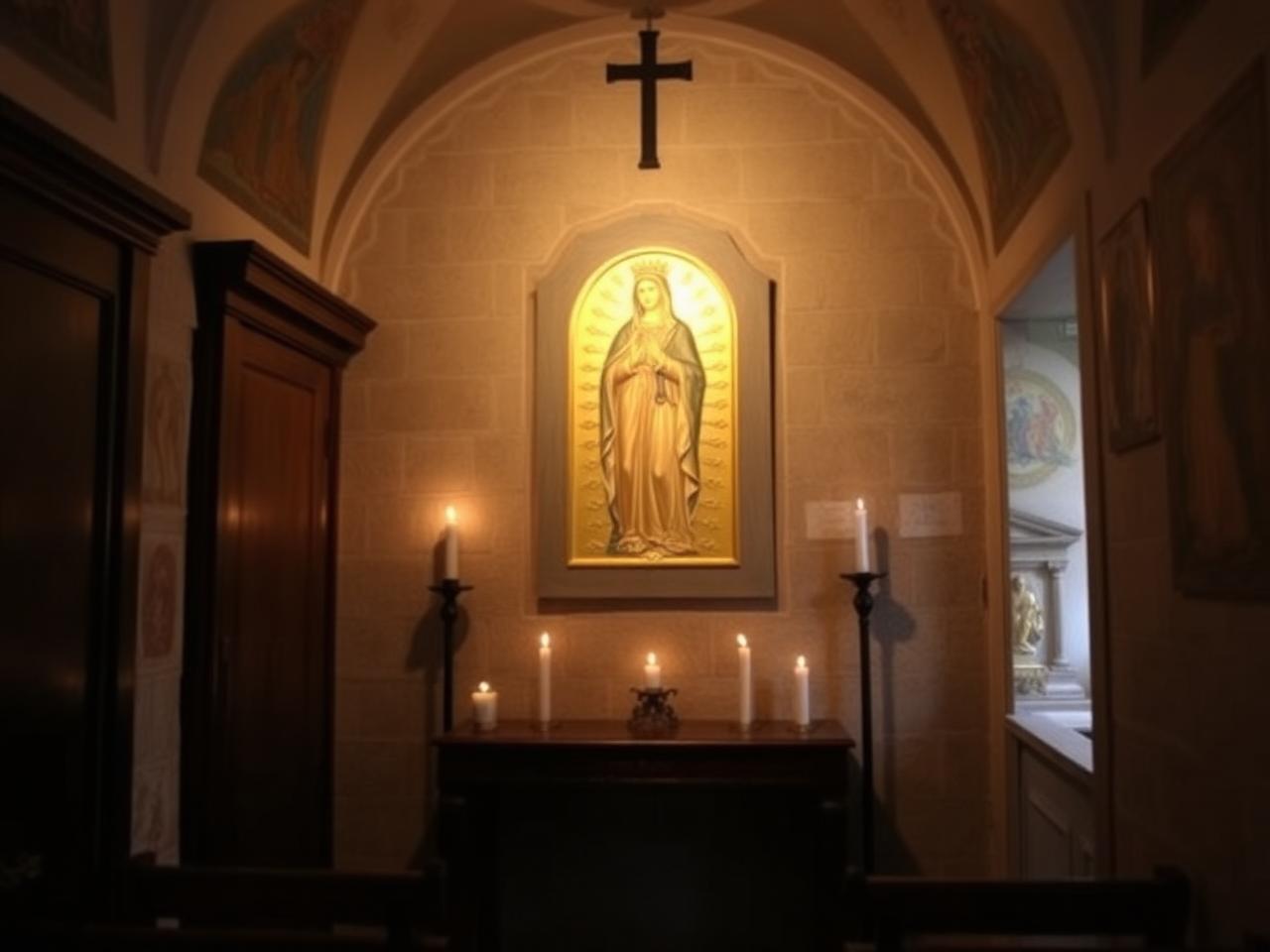
Pisciariello · The little Lourdes
Sanctuary of Maria SS. delle Grazie
The mystical heart of the village, on its northern edge. It holds a legendary icon of the Virgin painted on a four-and-a- half-quintal block of tuff, and the fresco of the Madonna enthroned between Saints Sebastian and Roch, signed by Master Iacopo and dated MCCCCCXXIIII (1524).
The miracle of Antonietta Fava
A twelve-year-old girl from the Vignai district, forced by her stepmother to wash clothes at night in the Pisciariello stream. A "gentle Lady" appeared to her, lighting up the path, and said: "Soak and wring… soak and wring, my child!" The miracle was not cosmic: it lifted the weight of an unfair task. The Virgin revealed herself only afterwards, asking that the chapel be built.
The site remained abandoned until 1951. It was Father don Giuseppe Struffi who turned its restoration into a building site for the post-war unemployed, an early but effective form of community welfare. The dig unearthed dozens of frescoes and the tuff icon that was thought lost.
7 August 1960: Cardinal Santiago Luis Copello crowned the icon. 7 August 2017: Bishop Orazio Francesco Piazza elevated the chapel to a diocesan Sanctuary under the title "Santa Maria delle Grazie, Help and Support of the Family".
Historic centre · Three naves
Mother Church of Saints Giovanni and Paolo
Both architectural and symbolic hinge between the upper districts of Vignai and the lower district of S. Janni. Built on an earlier structure and on a vast early-Christian cemetery layered by social class, clergy beneath the high altar, common people in the damp areas of the crypt.
15th-century frescoes
The Marriage of the Virgin and The Assumption of Mary, rediscovered under layers of lime on the soffit of a single-light window in the left nave.
Deposition (1599)
A dramatic canvas, precisely dated, on the right nave.
Baptism of Christ in the Jordan
Early-18th-century fresco that has re-emerged in the presbytery area.
Christ Carrying the Cross between Saints Giovanni and Paolo (1734)
A grand Baroque fresco above the high altar.
Carved doors of 1956
Sculpted by the local carpenter Giuseppe D'Angelo from drawings by Prof. Luigi Pietroluongo, inspired by the stations of the Passion.
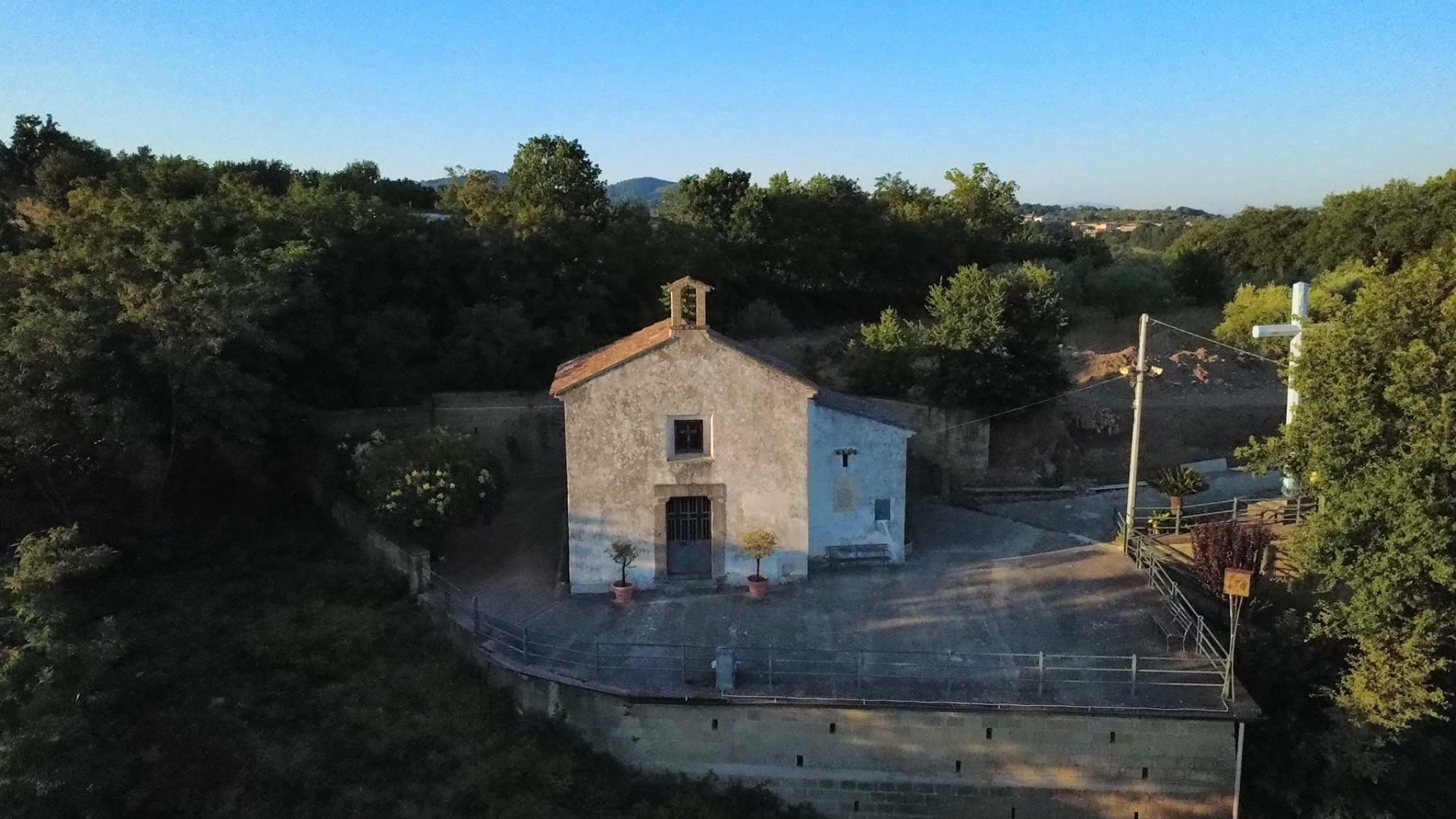
AD 61 · In the Apostle's footsteps
Chapel of Saint Paul the Apostle
The oldest and most legendary pillar of Casale's religious topography. Built in massive tuff blocks, with a single nave divided by a heavy round arch.
In February AD 61, after the shipwreck on Malta and his landing at Pozzuoli, Paul of Tarsus walked the Via Campana towards Rome. Tradition holds that he stopped right here, in the fields of Pilara, "the gate", preaching to farmers tending their vines. In welcome they offered him new wine and lupin beans. On the exact spot of that meal, centuries later, the chapel was built.
Archaeological surveys confirm it: the building stands on the remains of the deverticulum Adriani, a secondary road commissioned by Emperor Hadrian. The Rationes Decimarum Campaniae of 1308 and 1326 record the tithe payments for the chapel, its antiquity is also certified by the Vatican tax records.